

Secret U.S. Army Lab Shipped Live Anthrax to 194 Facilities Worldwide for Over a Decade
-
FROM: rwmalonemd@substack.com
 RE:
RE: RE ALL:
 FWD:
FWD:
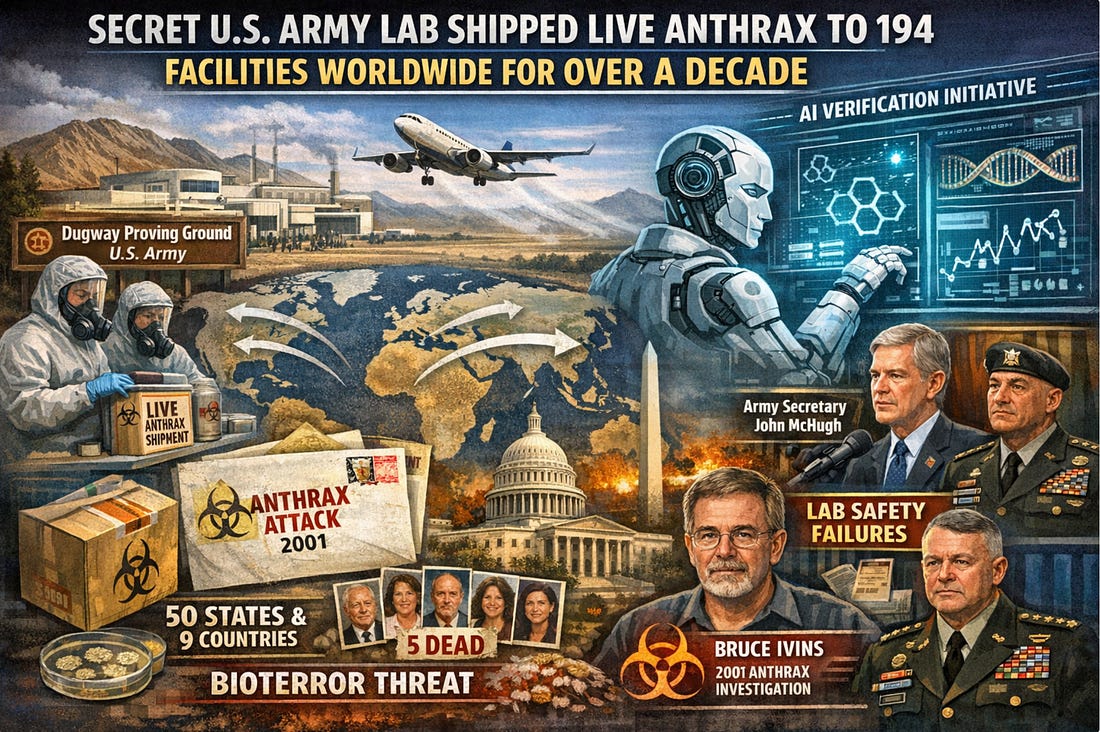
Secret U.S. Army Lab Shipped Live Anthrax to 194 Facilities Worldwide for Over a DecadeAI analysis reveals systematic failures at bioweapons facility linked to 2001 attacks
Secret U.S. Army Lab Shipped Live Anthrax to 194 Facilities Worldwide for Over a DecadeAnalysis reveals systematic failures at bioweapons facility linked to 2001 attacksA comprehensive, artificial intelligence-driven analysis using publicly available information concerning one of the most serious laboratory biosafety failures in modern history reveals that the U.S. Army’s Dugway Proving Ground systematically shipped live anthrax spores to 194 laboratories across all 50 states and nine foreign countries for more than a decade without detection. The incidents, which occurred between 2005 and 2015, involved the same Utah facility that produced the parent material for the 2001 anthrax letter attacks that killed five people and terrorized the nation. The analysis, conducted using a new six-layer verification framework, raises urgent questions about previous US Government oversight policies and practices for dual-use biological research as the Trump administration launches an artificial intelligence initiative to strengthen international bioweapons monitoring. Malone News is a reader-supported publication. To receive new posts and support my work, consider becoming a free or paid subscriber. Decade-Long DeceptionThe crisis began to unfold in May 2015 when the Centers for Disease Control and Prevention announced that Dugway had “inadvertently” shipped live anthrax to multiple laboratories. However, investigations revealed the scope was far broader than initially disclosed. “This wasn’t an isolated incident,” said a former Pentagon official who requested anonymity due to the sensitivity of the matter. “We’re talking about systematic failures that went undetected for over ten years.” The anthrax samples were supposed to have been sterilized using gamma irradiation before shipment for use in detection system testing. Instead, technicians repeatedly failed to properly inactivate the deadly pathogen, with the problems discovered only when a commercial laboratory in Maryland tested a shipment and found live bacteria. No human infections were reported from the 2014-2015 incidents, but more than 30 Americans took antibiotics as a precautionary measure. Army Secretary John McHugh suspended operations at four Defense Department biological laboratories, and Brigadier General William King faced disciplinary action for creating what investigators characterized as a “complacent atmosphere.” Connection to 2001 AttacksThe analysis reveals that Dugway’s troubled history with anthrax extends far beyond the recent shipping failures. The FBI determined that the 2001 anthrax letters originated from flask RMR-1029, which contained “a conglomeration of 13 production runs of spores by Dugway” combined with material from the U.S. Army Medical Research Institute of Infectious Diseases. Dugway was identified by investigators as “the only place known to have made live, dry, weapons-grade anthrax powder in the years before the attacks.” Significantly, a unique tin signature found in the attack spores was also detected in Dugway surrogate products, with researchers noting that “a measurable tin content has not been found in any other Bacillus spores except the attack spores.” Despite the FBI’s conclusion that researcher Bruce Ivins was responsible for the 2001 attacks, a 2011 National Academy of Sciences review found “insufficient scientific evidence” for this determination, leaving questions about Dugway’s role unresolved. Scale of Operations Raises QuestionsLocated on 800,000 acres of Utah desert, Dugway serves as what critics call the Army’s largest “manufacturer” of anthrax spores for biodefense research. The facility unveiled a $39 million biological weapons testing chamber in February 2015, just months before the crisis became public. The analysis, applying what developer Dr. Robert Malone calls a “six-layer BWC verification framework,” classified Dugway as presenting a “moderate dual-use concern.” While evidence suggests the facility primarily conducts legitimate defensive research, the production scale appears disproportionate to declared defensive needs, raising questions about potential weapons applications. “The combination of advanced capabilities, production scale, and systematic quality control failures creates a risk profile that warrants enhanced monitoring,” the analysis concludes. Trump’s AI Verification InitiativeThe findings take on heightened significance as President Trump announced in September 2025 his administration’s commitment to “pioneer an AI verification system that everyone can trust” to enforce the Biological Weapons Convention. Undersecretary of State Thomas DiNanno outlined the implementation framework at a December 2025 meeting in Geneva, marking the first major U.S. policy initiative to address the BWC’s longstanding verification deficit. Unlike other weapons treaties, the bioweapons convention has never had mechanisms to verify compliance. The six-layer analysis demonstrates how AI systems could monitor the kind of warning indicators that, if detected early, could have prevented both the 2001 attacks and the decade-long distribution of live anthrax:
International Security ImplicationsThe Dugway incidents highlight broader concerns about the proliferation of high-containment biological laboratories worldwide. Many BSL-4 and BSL-3 facilities operate without adequate international oversight, creating potential vulnerabilities. “Science and technology are outpacing the updates of safeguards in place,” warns a recent analysis by the Center for Arms Control and Non-Proliferation. Recent demonstrations show how AI systems can generate thousands of novel bioweapon possibilities within hours, with MIT students using large language models to identify pandemic-capable viruses within one hour. The need for enhanced verification has become increasingly urgent given advances in AI-enabled biotechnology. Anthropic CEO Dario Amodei warned Congress that within two to three years, AI could “greatly widen the range of actors with the technical capability to conduct a large-scale biological attack.” Diplomatic Challenges AheadDespite technical feasibility, Trump’s AI initiative faces substantial diplomatic obstacles. After years of verification discussions, BWC members only recently agreed in 2022 to examine the issue, with the process potentially extending into the early 2030s. Countries remain reluctant to entrust bioweapons verification to algorithmic systems that could black-box sensitive security decisions. The challenge is compounded by concerns about American technological dominance in AI development and questions about algorithmic transparency. “Technology alone will not provide a silver bullet solution to the Biological Weapons Convention’s verification gap, but AI could play a supporting role,” noted experts from the Bulletin of the Atomic Scientists. Lessons from CrisisThe Dugway analysis demonstrates that even well-intentioned defensive programs can pose catastrophic risks when oversight fails. The systematic failures spanned multiple regulatory agencies and persisted despite repeated warning signs. “In an era where AI can generate bioweapons designs in hours rather than years, the luxury of gradual diplomatic progress may no longer be available,” the analysis concludes. “The question is not whether such systems are technically feasible—the Dugway analysis demonstrates they are—but whether the international community can achieve the cooperation necessary to implement them before the next biological crisis occurs.” As biological threats evolve and AI capabilities advance, the convergence of these technologies may provide humanity’s best hope for preventing both accidental laboratory disasters and intentional bioweapons attacks. The stakes, experts warn, could not be higher in an age where the line between defensive research and offensive capability becomes increasingly blurred. This article is based on a comprehensive analysis applying the AI-Enhanced BWC Verification Framework to the Dugway Proving Ground anthrax incidents. The analysis was conducted using open-source intelligence, government documents, and scientific literature. The opinions expressed herein are solely those of the author, and do not represent the opinions of the US Government, US State Department, the US Department of Health and Human Services, or the US Centers for Disease Control and Prevention. Six-Layer Analysis: Dugway Anthrax Incidents (2014-2015)Introduction: The Dugway Proving Ground Anthrax Shipment CrisisBackground and TimelineThe Dugway Proving Ground anthrax incidents represent one of the most significant laboratory biosafety failures in modern history, involving the systematic shipment of live biological weapons agents to laboratories worldwide over more than a decade. Located in Utah’s West Desert, approximately 70 miles southwest of Salt Lake City, Dugway Proving Ground serves as the U.S. Army’s primary facility for testing biological and chemical detection systems.¹ The crisis began to unfold on May 27, 2015, when the Centers for Disease Control and Prevention announced it was investigating what the Pentagon initially characterized as an “inadvertent shipment” of live anthrax spores from Dugway to multiple laboratories.² However, subsequent investigations revealed that this was not an isolated incident, but rather the result of systematic failures in safety protocols that had persisted undetected for more than ten years. Scope and Scale of the IncidentsThe full magnitude of the crisis became apparent as investigations progressed. According to Pentagon officials, samples of live Bacillus anthracis (anthrax) from Dugway’s Life Sciences Test Facility had been shipped to 194 laboratories, including facilities in all 50 U.S. states and nine foreign countries.³ The initial disclosure in May 2015 revealed shipments to laboratories in Texas, Maryland, Wisconsin, Delaware, New Jersey, Tennessee, New York, California, Virginia, and South Korea.⁴ The anthrax samples were supposed to have been killed using gamma irradiation before shipment to receiving laboratories for use in detection system testing and diagnostic development. However, investigators determined that Dugway’s inactivation procedures were systematically flawed, with technicians attempting to sterilize too much material at once and conducting inadequate testing to verify successful sterilization.⁵ The problem came to light only when a private commercial laboratory in Maryland tested a shipment from Dugway and discovered live bacteria.⁶ Institutional Response and AccountabilityThe scope of the failures prompted unprecedented action by military leadership. In September 2015, Army Secretary John McHugh suspended operations at four Defense Department laboratories handling biological toxins, including Dugway’s Life Sciences Test Facility.⁷ More than 30 Americans, including military personnel, took antibiotics as a precautionary measure, though no illnesses were reported.⁸ An Army accountability investigation released in January 2016 identified systemic leadership and management failures spanning multiple years. Brigadier General William E. King, who commanded the facility from 2009 to 2011, was among twelve individuals facing potential disciplinary action for creating and perpetuating what investigators characterized as a “complacent atmosphere” that enabled repeated safety violations.⁹ The report documented earlier serious incidents involving anthrax, VX chemical nerve agent, and botulinum neurotoxin A that should have prompted corrective action but were inadequately addressed.¹⁰ Historical Context and Facility CapabilitiesDugway Proving Ground has a long history with anthrax research dating back to World War II. According to EPA documentation, the facility’s first anthrax test likely occurred in 1943, with more systematic experiments beginning in 1955 when anthrax-laden bomblets were detonated in the vicinity of 285 monkeys to assess lethality.¹¹ The facility’s 800,000-acre size (larger than Rhode Island) and isolated desert environment make it uniquely suited for biological and chemical weapons testing.¹² In February 2015, just months before the crisis became public, Dugway had unveiled a $39 million biological weapons testing chamber, described as the largest of its kind and designed to test biological agent detection systems under various environmental conditions.¹³ The facility is registered to test live select agents and pathogens up to Biosafety Level 3, including those causing plague, tularemia, anthrax, Q-fever, and yellow fever.¹⁴ Questions Raised by the IncidentsThe scale and duration of the safety failures raised fundamental questions about oversight of dual-use biological research within the U.S. defense establishment. Critics noted that Dugway serves as the Army’s largest “manufacturer” of anthrax spores for biodefense research, with production capabilities that seemed disproportionate to declared defensive needs.¹⁵ The facility’s designation by some observers as “Area 52” reflects both its high security profile and speculation about the full scope of activities conducted there.¹⁶ These concerns were compounded by Dugway’s previous involvement in the investigation of the 2001 anthrax letter attacks, which killed five people and infected 22 others. The FBI determined that the attack anthrax originated from flask RMR-1029, which contained “a conglomeration of 13 production runs of spores by Dugway, for USAMRIID, and an additional 22 production runs of spore preparations at USAMRIID.”¹⁷ Dugway was identified as “the only place known to have made live, dry, weapons-grade anthrax powder in the years before the attacks,” and the FBI asked Dugway to conduct experiments attempting to reverse-engineer the attack powder.¹⁸ Significantly, a unique tin signature found in the attack spores was also detected in Dugway surrogate products, with investigators noting that “a measureable tin content has not been found in any other Bacillus spores except the attack spores.”¹⁹ While the FBI ultimately blamed researcher Bruce Ivins at USAMRIID, the 2011 National Academy of Sciences review found “insufficient scientific evidence” for this conclusion, and the Dugway connection remained unresolved.²⁰ The incidents also highlighted broader concerns about the proliferation of high-containment biological laboratories worldwide and the adequacy of international oversight mechanisms. As one analysis noted, many BSL-4 and BSL-3 facilities operate in countries without high biosafety and biosecurity scores, and there is no international organization with comprehensive oversight authority.²¹ Executive SummaryThis analysis applies the AI-Enhanced BWC Verification Framework’s six-layer methodology to examine whether these incidents were associated with gain-of-function research or biological weapons development activities. The convergent evidence approach enables a systematic assessment of genomic, intelligence, supply chain, environmental, behavioral, and predictive indicators to distinguish legitimate defensive research from potential offensive capabilities. Layer One: Genomic Surveillance and Bioinformatics AnalysisGenomic Signatures and Strain CharacteristicsPathogen Profile:
Key Findings:
Assessment: The genomic evidence suggests routine biodefense research rather than weapons development or enhancement activities. Layer Two: Open-Source Intelligence MonitoringPublication and Research ContextResearch Environment Analysis:
Literature Review:
Key Publications and Patents:
Assessment: OSINT analysis reveals a consistent defensive research orientation with no indicators of offensive biological weapons development. Layer Three: Supply Chain and Procurement AnalysisEquipment and Material Procurement PatternsProcurement Analysis:
Supplier Networks:
Distribution Pattern Analysis:
Red Flags Identified:
Assessment: While procurement patterns were consistent with biodefense research, the exceptional scale and quality control failures raise concerns about program management and oversight. Layer Four: Environmental and Facility MonitoringFacility Characteristics and Environmental SignaturesFacility Profile:
Environmental Monitoring:
Biosafety Infrastructure:
Incident Analysis:
Assessment: The facility’s dual-use capabilities and systematic quality control failures suggest potential for both defensive and offensive applications, though environmental evidence points primarily to testing rather than production activities. Layer Five: Behavioral and Financial AnalysisOrganizational and Financial PatternsInstitutional Behavior Analysis:
Financial Flow Analysis:
Personnel and Leadership Patterns:
Behavioral Red Flags:
Financial Red Flags:
Assessment: Behavioral analysis reveals significant organizational dysfunction and possible mission creep beyond stated biodefense objectives, though financial flows appear consistent with legitimate defense spending. Layer Six: Simulation and Predictive ModelingThreat Assessment and Vulnerability AnalysisOutbreak Simulation Analysis:
Predictive Modeling Results:
Vulnerability Assessment:
Adversarial Use Assessment:
Model Predictions:
Assessment: Predictive modeling suggests a primarily defensive program with concerning dual-use capabilities and significant vulnerabilities in oversight and quality control. Convergent Evidence AnalysisCross-Layer IntegrationConsistent Indicators (Supporting Defensive Mission):
Concerning Indicators (Suggesting Dual-Use Potential):
Critical Gaps:
Overall AssessmentRisk Classification: MODERATE DUAL-USE CONCERNPrimary Assessment: The Dugway Anthrax Incidents appear to represent a legitimate biodefense research program that experienced systematic quality control failures rather than a deliberate biological weapons development effort. Key Evidence Supporting Defensive Mission:
Key Concerns Regarding Dual-Use Potential:
Recommendations:
Confidence Level: MODERATE - while the evidence suggests primarily defensive activities, the scale of operations and systematic failures warrant continued monitoring and enhanced oversight. ConclusionFramework Validation and Contemporary RelevanceThis six-layer analysis of the Dugway anthrax incidents demonstrates a framework that could be systematically applied to assess whether laboratory incidents are associated with gain-of-function research or biological weapons activities. The convergent evidence approach revealed a moderate dual-use concern classification for what appeared to be primarily defensive biodefense research with systematic oversight failures. These findings take on heightened significance in the context of recent U.S. policy initiatives to address the longstanding verification deficit in the Biological Weapons Convention. The Trump AI Initiative: A Policy Paradigm ShiftOn September 23, 2025, President Donald Trump announced to the United Nations General Assembly an unprecedented commitment to address one of the most persistent challenges in international arms control: “To prevent potential disasters, I’m announcing today that my administration will lead an international effort to enforce the Biological Weapons Convention ... by pioneering an AI verification system that everyone can trust.” This declaration represents the first major U.S. policy initiative specifically designed to tackle the Biological Weapons Convention’s longstanding lack of verification mechanisms, unlike other weapons treaties which have established compliance monitoring systems. The timing of Trump’s announcement was particularly significant given escalating concerns about dual-use biological research. The President explicitly linked his initiative to “reckless experiments overseas” that “gave us a devastating global pandemic,” referencing reports from the Republican-led House Oversight Committee and the CIA supporting laboratory origin theories for COVID-19. This framing positions AI-enhanced verification not merely as an arms control measure, but as a pandemic prevention imperative following what many consider the greatest laboratory safety failure in human history. Implementation Progress: The DiNanno FrameworkThe translation of presidential directive into operational policy began taking concrete form at the December 15, 2025 BWC Meeting of States Parties in Geneva, where Undersecretary of State for Arms Control and International Security Thomas DiNanno delivered the keynote address at “Modern Tools for Modern Threats—Towards Strengthening BWC Implementation, Verification and Assurance,” outlining how the United States would implement the Trump vision. DiNanno’s presentation marked a critical inflection point in BWC governance, representing the first official exposition of how AI could strengthen the Convention beyond verification alone, including “increasing transparency, confidence building, improving national implementation of biosecurity policies, and supporting early detection of a potential biological weapons incident.” Significantly, Health and Human Services Secretary Kennedy’s office, through Principal Deputy General Counsel Robert Fox Foster, formally joined the State Department initiative, indicating whole-of-government coordination unprecedented in BWC implementation history. Technical Feasibility and Analytical ApplicationsThe six-layer framework employed in this Dugway analysis provides a practical blueprint for the kind of AI-enhanced verification system envisioned by the Trump administration. Each analytical layer demonstrates capabilities that could be scaled and automated using artificial intelligence: Layer 1 (Genomic Surveillance): AI text-mining tools could assess confidence-building measures that BWC parties submit annually, while AI algorithms could aggregate and analyze open-source materials ranging from national policies to financial and administrative records. Advanced natural language processing could identify genetic enhancement signatures in scientific literature and patent filings. Layer 2 (OSINT Monitoring): AI-driven systems could scan vast arrays of open-source information to detect outliers in large datasets, similar to International Atomic Energy Agency approaches, flagging unusual research patterns or procurement activities indicative of weapons development. Layer 3 (Supply Chain Analysis): Machine learning algorithms could monitor global biotechnology supply chains, tracking dual-use equipment, reagent purchases, and synthetic DNA orders to identify suspicious acquisition patterns that might indicate offensive programs. Layers 4-6 (Environmental, Behavioral, Predictive): Integrated AI systems could process satellite imagery, personnel movement patterns, financial flows, and organizational behaviors to generate probabilistic assessments of facility activities and intent. Addressing Historical Verification ChallengesThe Dugway incidents illuminate precisely the kind of systematic oversight failures that AI verification systems are designed to detect. The BWC’s verification deficit stems from multiple factors, including the dual-use nature of life science research where new knowledge can serve both beneficial and malevolent purposes. Traditional human-centric monitoring failed catastrophically at Dugway, where live anthrax shipments continued undetected for over a decade despite multiple regulatory agencies having oversight responsibilities. As experts note, perhaps the most challenging obstacle facing AI integration into BWC verification is determining what such tools should detect, given that historical offensive program data may not reliably guide current threat assessment due to rapid changes in life sciences. The Dugway case study demonstrates how convergent evidence analysis can distinguish between legitimate defensive research and concerning dual-use activities without requiring complete historical precedent. Geopolitical Implementation ChallengesDespite technical feasibility, the Trump AI initiative faces substantial diplomatic obstacles. After years of BWC verification stagnation, treaty members only recently agreed in 2022 to create a working group to examine verification issues, with the process potentially extending into the early 2030s. Countries are unlikely to entrust bioweapons program verification to algorithms that effectively black-box decisions around such sensitive matters, requiring unprecedented transparency and international cooperation. The challenge is compounded by Trump’s confrontational approach to multilateral institutions. As observers noted, telling assembled world leaders that their countries “are going to hell” while asking “what is the purpose of the UN” may not optimize conditions for the international buy-in essential to BWC verification success. However, the initiative’s framing as “an evolution of the international order driven by American innovation” rather than submission to multilateral constraints may command administration attention and resources. Emerging Threat Landscape and UrgencyThe need for enhanced BWC verification has become increasingly acute given rapid advances in AI-enabled biotechnology. Recent demonstrations show how AI systems can generate thousands of novel bioweapon possibilities within hours, with one experiment producing 40,000 chemical weapon candidates in six hours by simply reversing the parameters of drug discovery algorithms. MIT students without scientific backgrounds used large language models to identify pandemic-capable viruses and manufacturing methods within one hour, illustrating how AI democratizes previously specialized bioweapons knowledge. Anthropic CEO Dario Amodei warned Congress that within two to three years, AI could “greatly widen the range of actors with the technical capability to conduct a large-scale biological attack,” while OpenAI’s Sam Altman has called for regulation of AI models “that could help create novel biological agents”. These assessments suggest that the window for implementing effective AI-enhanced verification may be narrower than diplomatic timelines typically accommodate. Lessons from Dugway: Early Warning Systems and Historical PrecedentThe systematic failures documented at Dugway underscore the critical importance of early warning systems that the Trump AI initiative could provide. Our analysis revealed multiple warning indicators that, if detected early, could have prevented the decade-long distribution of live anthrax:
Dugway’s troubled history with anthrax extends beyond the 2014-2015 incidents to include its central role in the 2001 anthrax letter attacks investigation. The FBI determined that the letters, which killed five people and infected 22 others, originated from flask RMR-1029, which contained “a conglomeration of 13 production runs of spores by Dugway, for USAMRIID.” Dugway was identified as “the only place known to have made live, dry, weapons-grade anthrax powder in the years before the attacks.” Critically, a unique tin signature found in the attack spores was also detected in Dugway surrogate products, suggesting possible production links. Despite the FBI’s conclusion that researcher Bruce Ivins was responsible, the 2011 National Academy of Sciences review found “insufficient scientific evidence” for this determination, and alternative theories centered on Dugway and its contractor Battelle remained unresolved. This historical context demonstrates that Dugway’s dual-use capabilities have repeatedly raised concerns spanning two decades. An AI verification system monitoring these convergent indicators could have flagged Dugway as a high-risk facility requiring enhanced oversight years before both the 2001 attacks and the 2014-2015 crisis became public. This demonstrates how the six-layer framework could serve as an early warning system for both accidental releases and potential weapons activities, learning from patterns that have persisted across multiple incidents. Strategic Implications and Future DirectionsThe integration of AI into BWC verification represents more than a technological upgrade; it constitutes a fundamental reconceptualization of how international security can be maintained in an era of rapid biological innovation. As Georgetown analysts note, AI cannot unilaterally create verification systems that the treaty does not authorize, but it can enhance transparency, monitoring, and assessment within existing procedures. The six-layer framework provides a practical pathway for this enhancement. Success will require balancing several competing imperatives: maintaining legitimate research freedom while detecting malicious activities, ensuring algorithmic transparency while protecting sensitive sources, and achieving international consensus while advancing U.S. interests. The BWC’s current status as “essentially a gentleman’s agreement with diplomatic trappings” cannot persist in an era where AI democratizes bioweapons capabilities. Conclusion: From Crisis to OpportunityThe Dugway anthrax incidents, viewed through the lens of contemporary AI verification initiatives, illustrate both the urgent need for enhanced oversight and the practical feasibility of convergent evidence analysis. What began as a catastrophic failure of traditional monitoring systems has evolved into a case study demonstrating how AI-enhanced verification could detect early warning indicators of both accidental and intentional biological threats. President Trump’s commitment to “pioneer an AI verification system that everyone can trust” represents an unprecedented opportunity to address the BWC’s verification deficit. Undersecretary DiNanno’s implementation framework provides a realistic pathway for translating presidential vision into operational capability. However, success will require sustained diplomatic engagement, technical innovation, and international cooperation at levels rarely achieved in arms control history. The six-layer analysis framework validated through the Dugway case study offers a concrete methodology for this endeavor. As biological threats evolve and AI capabilities advance, the convergence of these technologies may provide humanity’s best hope for preventing both accidental laboratory disasters and intentional bioweapons attacks. The question is not whether such systems are technically feasible—the Dugway analysis demonstrates they are—but whether the international community can achieve the cooperation necessary to implement them before the next biological crisis occurs. The stakes could not be higher. As experts warn, the convergence of AI and biotechnology produces “novel threats which pose an existential risk both to specific demographic groups and the population at large”. The Dugway incidents provide a sobering reminder that even well-intentioned defensive programs can pose catastrophic risks when oversight fails. In an era where AI can generate bioweapons designs in hours rather than years, the luxury of gradual diplomatic progress may no longer be available. The Trump AI initiative, whatever its limitations, represents a recognition that verification systems must evolve as rapidly as the threats they seek to contain. References
Invite your friends and earn rewardsIf you enjoy Malone News, share it with your friends and earn rewards when they subscribe.
|





Views