

Made in Venezuela: Iranian Drones
-
FROM: rwmalonemd@substack.com
 RE:
RE: RE ALL:
 FWD:
FWD:
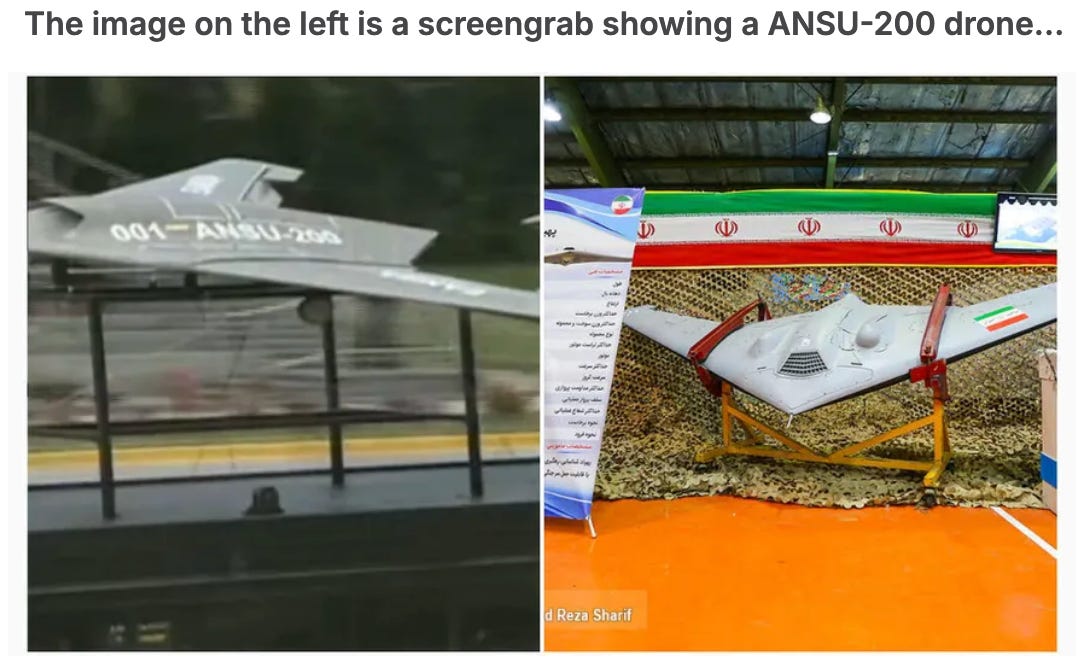
Made in Venezuela: Iranian DronesThank you, Mr. President. Few seem aware of the interwoven strategic geopolitical relationships at play behind the headlines coming from both Iran and Venezuela. However, you can rest assured that neither Secretary of State Rubio, nor POTUS Donald Trump is so naive. The recent action against Nicolás Maduro was billed as taking aggressive steps against a chronic sponsor of narcoterrorism, but the issues are much deeper. At this very moment, a politically diverse range of social media influencers are busy criticizing this intervention. Still, none seem to be aware of or accounting for these deeper geopolitical issues. This is not tiddlywinks, folks. This involves serious national security and geopolitical alliance issues. Yes, Virginia, there are clear ties between Iran and Venezuela, as there are between China and Venezuela. This is not some hyped up propaganda about chemical warfare or weapons of mass destruction, like what was used to justify the Iraq war. What we have here is clear, present, multidimensional danger. It is helpful to dissect this strategically, because most mainstream reporting examines it only through the lens of sanctions or “rogue states cooperating,” while missing the deeper reality of the relationship. This isn’t just geopolitics; it’s the new face of modular, sanctions-resistant warfare. Let’s focus on one example to illustrate the point. Over the past several years, there has been substantial evidence that Iran has indeed helped Venezuela establish local drone manufacturing capacity, particularly of Iranian-designed UAVs like the Mohajer and Shahed families. The Core of the Iran–Venezuela Drone CollaborationIran and Venezuela have been under heavy U.S. sanctions for years. Both nations share a strategy of technological autarky. Technological autarky is the policy goal of making a country self-sufficient in critical technologies, so it does not rely on foreign nations for the development, production, or maintenance of essential tech systems. Both countries are considered rogue and, over the years, have faced numerous economic embargoes. Iran’s drone program is one of its most successful export-ready industries. Drones became Iran’s key asymmetric deterrent capability in the 2010s and 2020s, primarily through the Islamic Revolutionary Guard Corps (IRGC). Around 2022, reports emerged that Venezuela had opened facilities believed to be assembling Iranian Shahed drones, possibly under local rebranding such as the “ANSU-200” or “Mohajer-6 variant.” The collaboration seems focused in the Aragua state near the CAVIM (Compañía Anónima Venezolana de Industrias Militares) complex. Engineers from Iran reportedly supplied designs, parts, and training for Venezuelan technicians.
This fits into Tehran’s expansion of its “Axis of Resistance” strategy. Tehran’s “Axis of Resistance” is best understood as an Iranian-led proxy network created to destabilize the Middle East and elsewhere while providing Iran with plausible deniability. Instead of directly confronting the United States or Israel, Iran funds, supplies, and trains militant groups such as Hezbollah, Hamas, the Houthis, and aligned militias in Iraq and Syria to carry out asymmetric warfare, threaten civilians, and disrupt global trade routes. This approach allows Tehran to expand its regional influence, encircle Israel, pressure U.S. allies, and weaken sovereign governments, all while avoiding the risks of open conflict. In reality, the “Axis” functions less as a defensive alliance and more as a state-sponsored terror network that sustains conflict and erodes regional stability. 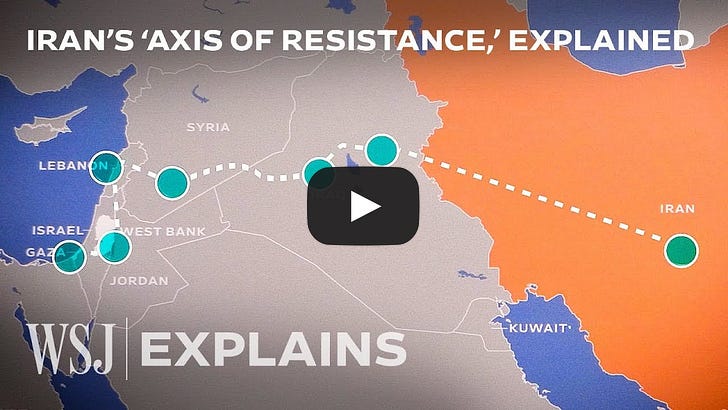 This is why Iran has established drone manufacturing hubs in friendly states to export influence. And as for Caracas, drones have offered internal security leverage and a psychological counterweight to the United States and Colombia. This is not pure outsourcing like a corporation would do; it’s a strategic joint technological transfer. Iran effectively externalized parts of its drone production: components, training, or even complete assembly lines to allied nations, including:
Venezuela functions as a Latin American manufacturing node that reduces Iran’s logistical and political exposure while creating a regional arms customer base aligned with anti-U.S. movements. Independent and institutional open sources converge on the strategic truth of the following factual points:
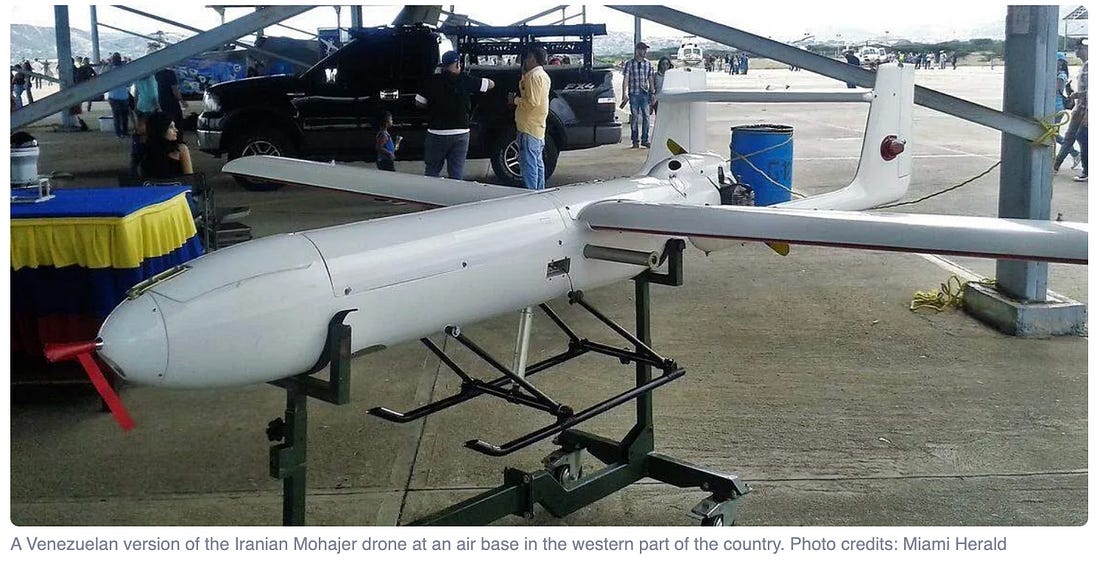
Interested observers can easily verify the entire structure of the claim through these open publications; it’s not a rumor, it’s fully documented in official and defense-sector reporting across 2022–2024 (references found at the end of this article) In early 2026, the use of Iranian-made drones by Venezuela has intensified, with the Mohajer-6 drone now reportedly operational in the Venezuelan military, capable of both surveillance and armed strikes. This development follows years of cooperation between Iran and Venezuela, including the transfer of drone technology and munitions, with U.S. sanctions targeting entities involved in the production and assembly of these drones in Venezuela. The United States has consistently accused Iran of supplying drones and precision-guided munitions to Venezuela, a claim Iran denies.
New photographic evidence confirms the deployment of Iranian-made Mohajer-6 unmanned aerial vehicles (UAVs) at Venezuela’s El Libertador Air Base, marking the first visual confirmation of the drone’s operational presence in Latin America and highlighting the deepening military cooperation between Iran and Venezuela. This development underscores the expansion of Venezuela’s drone capabilities, now including armed reconnaissance platforms produced with Iranian assistance, which pose new operational risks to U.S. forces in the Caribbean region.
Implications
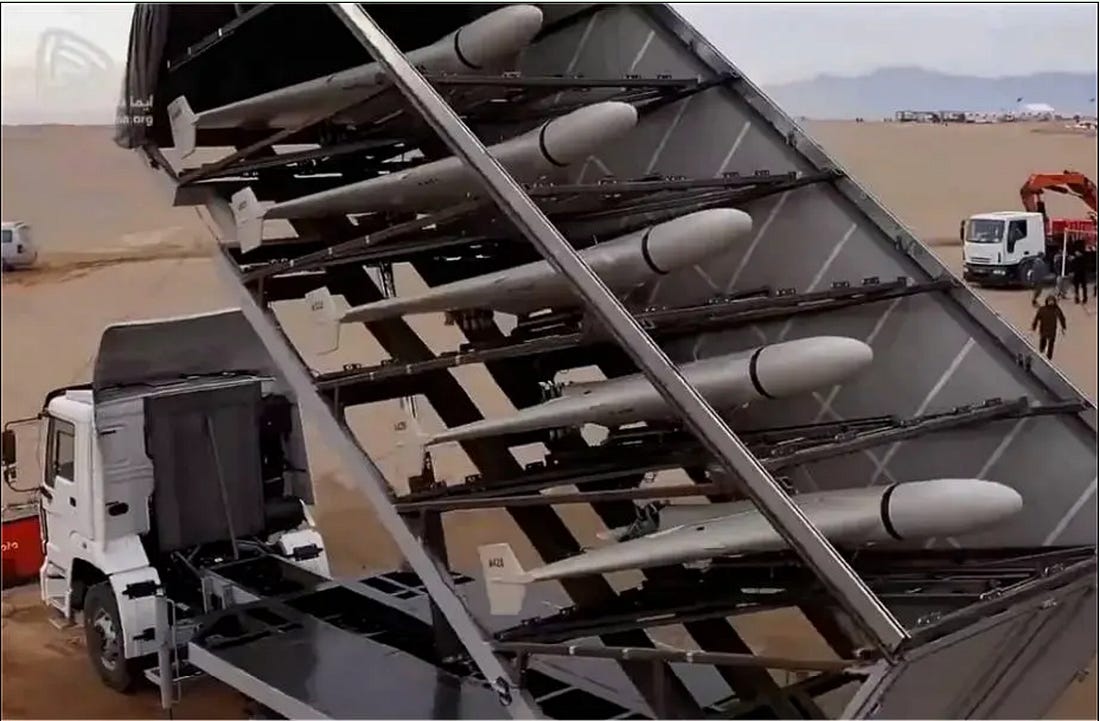
Iran has effectively outsourced or co-established drone production in Venezuela. But that wording downplays it: it’s part of a decentralized manufacturing strategy, turning Iranian drone technologies into a distributed, deniable export industry that uses their “Axis of Resistance” partner nations’ facilities and local labor. This isn’t just geopolitics; it’s the new face of modular, sanctions-resistant warfare. ConclusionThe rise of Iranian drones, which are “Made in Venezuela,” marks a pivotal transformation in how state power and warfare are projected under the shadow of sanctions. So, what some dismiss as peripheral cooperation is, in truth, a calculated step in a broader pattern of distributed deterrence. These rogue nation-states are learning to duplicate, conceal, and localize military technology outside the reach of Western pressure. The Iran–Venezuela drone partnership is not an isolated curiosity; it is a blueprint for how sanctioned states will survive and adapt in the coming decade. If the United States and its allies fail to grasp this shift, they will continue to misread the architecture of global power; focusing on visible battlefields while ignoring a sprawling network of silent factories, hidden engineers, and modular weapons ecosystems operating far beyond conventional oversight. The battlefield of the 2020s is not merely kinetic; it is manufactured in the margins. And drone capabilities and manufacturing capacity will play a key role in determining the outcome of kinetic warfare for the foreseeable future. Current Iranian military leadership is many things, but stupid is not one of them. Malone News is a reader-supported publication. To receive new posts and support my work, consider becoming a free or paid subscriber. References:Israel accuses Iran of providing munitions for drones supplied to Venezuela, Reuters February 22, 20221:51 PM EST U.S. issues new Iran-related sanctions -Treasury Dept website. By Doina Chiacu October 18, 20231:32 PM EDT U.S. asks Argentina to seize Venezuelan plane linked to Iran. Reuters August 2, 20229:55 PM EDT Iranian Strike-Surveillance Drones Are Now Operating In Venezuela. Venezuela has been working for years to get Mohajer-6s, which can surveil and strike targets, and other Iranian types could pose even greater problems. Joseph Trevithick Updated Dec 31, 2025 8:40 PM EST US Issues further sanctions on Iran, Targets Drones. Reuters. 2024-04-25 US Issues Sanctions Related to Iran and Venezuela Weapons Trade. Reuters. Dec 30, 2025 US Imposes Sanctions on Venezuelan and Iranian Companies Over Combat Drone Network Linked to the Maduro Regime. Gateway Hispanic. Mariana Ramirez Medina Jan. 2, 2026 1:00 pm The Drone Attack That Shook Venezuela. By OilPrice.com Editorial Dept- Jan 02, 2026, 8:30 AM CST *The Shahed-136 is an Iranian-made loitering ammunition also called suicide or kamikaze drone developed and manufactured by Iran Aircraft Manufacturing Industrial Company (HESA). The company was established in 1976, it belongs to the Iran Aviation Industries Organization (IAIO) and is located at Shahin Shahr, Isfahan. The original factory, built by Textron, was to produce Bell 214s of different configurations in Iran with a deal that involved several hundred helicopters and technology transfers. The drone is designed to conduct ground attacks. The Shahed-136 is not only a suicide drone and according to pictures released by Iranian media, Iran has also created a new way to launch the drones in a kind of multiple-launch, or drone-swarming, format. Drone swarms are a new technology whereby multiple drones are used to strike targets. The drone was unveiled in 2021 and is now used by the Russian army in Ukraine. According to Newsweek, an American weekly online news magazine, as early as 2020 they were being used by Houthi groups in Yemen. According to information released by the Ukrainian government on October 23, 2022, Russia has ordered 2,400 Iranian-made Shahed-136 suicide drones from Iran. Shahed-136, 23 Nov, 2025 - 14:46 Armyrecognition.com Invite your friends and earn rewardsIf you enjoy Malone News, share it with your friends and earn rewards when they subscribe.
|





Views