

how to ask for advice (without wasting everyone's time)
-
FROM: auren@substack.com
 RE:
RE: RE ALL:
 FWD:
FWD:
how to ask for advice (without wasting everyone's time)97.4% of people who ask for advice do it wrong.
they show up with vague questions, little preparation, and somehow expect the other person to do all the thinking. then they wonder why the conversation went nowhere and the person never responded to their follow-up. don’t be that person. if you want help -- if you want real advice -- there’s a right way to get it. and most people never learn it because no one tells them. so here it is. (this is the companion piece to how to ask for an introduction and how to actually look for a job. the principles overlap -- specificity wins, vagueness kills, and nobody wants to do your thinking for you.)
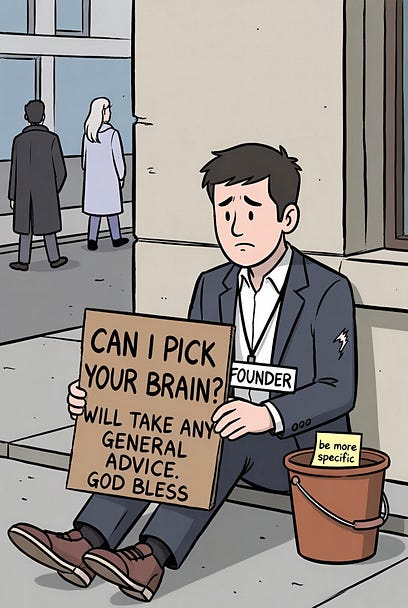
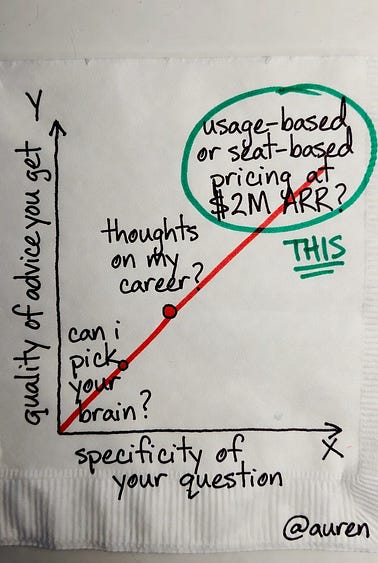
know what you’re actually asking forthe single biggest mistake: asking for “general” advice. “i’d love to pick your brain” is the worst sentence in the english language. it means nothing. it tells the other person nothing. and you will leave the conversation with nothing. it’s the advice equivalent of “let’s grab coffee sometime” -- which, as i wrote in the job search piece, is not a pitch. it’s a cry for help. if you show up and say “i’m just exploring options” or “i’d love your general thoughts on my career,” the advice-giver has to do all the work. they have to figure out what you need, guess at your context, and improvise something useful on the fly. most people are not good at that. even really smart people. the result is generic advice that doesn’t apply to your situation. and now you’ve wasted 30 minutes of both of your lives. come in with a specific ask.
if you find yourself unable to articulate a specific question, that’s a sign you need to do more thinking BEFORE you ask for the meeting. you’re not ready. go sit with a notebook and some honesty. yes, don’t be a little cry baby: figure it out yourself first. before you ask a person, ask AIthis should be obvious by now but 80% of the questions people ask me, AI would give a better answer than i would. that sounds like false modesty. it’s not. AI has access to more information, it’s infinitely patient, and it won’t judge you for asking a dumb question. i will. (ok maybe i won’t judge you out loud. but i’m thinking it.) if your question is factual -- “what’s the standard vesting schedule for early employees” or “what are the pros and cons of a SAFE vs priced round” -- AI will crush it. don’t burn a favor on something you can get for free in 30 seconds. save your people asks for things that ONLY a person can give you. judgment calls. pattern recognition from lived experience. access to their network. opinions formed over decades of actually doing the thing. that’s what’s valuable. that’s what you can’t prompt. if you’re not sure whether AI can answer your question, try it first. if the answer is good, you just saved yourself and someone else 30 minutes. if the answer is generic or wrong, now you know this is a question worth asking a human. make sure the person can actually help youi get dozens of inbounds a week asking me for advice. i genuinely want to help everyone. but most of the time, the person wants advice on something i know almost nothing about. that’s just bad targeting. your friends WANT to help you. your network WANTS to help you. So let them help you: ask them for advice on things they can actually help with. just because a person is successful in their business does not mean they can help with all businesses. success in one domain does not transfer to all domains. if a person has never played golf, you’d never ask their advice about the best golf courses -- even if they’re an amazing skier. same thing goes for business advice. the best advice-askers are surgical about who they ask for what. they’ll ask one person about pricing, a different person about hiring, and a third person about fundraising. they don’t try to extract everything from one 20-minute conversation. they treat advice like a portfolio -- diversified across the people who are BEST positioned to answer each specific question. research the person before you reach outhas the advice-giver already written about this topic? already talked about it on a podcast? already tweeted about it 15 times? if so, you need to know that before the conversation starts. nothing is more deflating than someone asking you a question you’ve publicly answered a dozen times. it tells you they did zero homework. and the unspoken conclusion: if they didn’t care enough to spend 10 minutes researching, why should you spend 30 minutes helping them? here’s the move. before asking anyone for advice, write a very specific prompt to AI first. if i want to learn more about seed investing from Tod Sacerdoti, i’d first ask AI what he’s said about it publicly. here’s an example: gemini prompt on Tod Sacerdoti you can take it even further. before talking to someone with a public profile, ask AI to assume the personality of that person. here’s an example of asking Ken Griffin (CEO of Citadel) for advice on whether you should move to Miami: gemini prompt as Ken Griffin this is not cheating. this is called preparation. you walk into the real conversation already past the surface-level stuff, which means you can ask the DEEP questions only that person can uniquely answer. they’ll notice the difference immediately. and they’ll enjoy the conversation way more because you’re not making them repeat their greatest hits. never ask for a call when an email will dosometimes you just need a specific thing. an intro. a quick opinion. a sanity check on a number. if so, just ask via email. in my piece on how to ask for an introduction, we discuss how the best intro requests are short, clear, and email-forwardable. same principle applies here. if your advice question can be answered in 2-3 sentences, send an email. don’t make someone coordinate calendars and block 30 minutes for something that takes 30 seconds. a meeting costs the other person way more than the meeting itself. there’s the context switch, the calendar tetris, the mental overhead of having a commitment on the books. respect that. the bar for asking someone to block time on their calendar should be really high. rule of thumb: if the question requires real-time back-and-forth, nuance, or judgment that’s hard to convey in text -- call. everything else? email. when you do reach out, be specific about what you need never say “can i get 10 minutes of your time” without the person knowing what it’s about. you will NOT get more help by surprising them. the opposite actually. people give dramatically better advice when they’ve had even 5 minutes to think about the topic beforehand. you’re robbing them of that if you ambush them with a vague ask. put together a quick agenda. even two bullet points. “i’m trying to decide between two go-to-market approaches and would love your take, given your experience scaling [X].” one sentence. tells them everything. they show up ready. and the conversation is 5x more useful for both of you. this is the same principle from the intro piece -- a good intro email has a clear subject line and a clear reason for the target to care. a good advice ask works the same way. tell them EXACTLY what you need so they can decide if they’re the right person to help. ask in publicsometimes the best way to ask for advice is to ask in public. tag the person on X or LinkedIn. this is especially true if you don’t know the person well and they’re active on social media. many people -- me included -- are always looking for content. public questions are a gift. they give the advice-giver a chance to look smart in front of their audience while helping you at the same time. that’s a win-win that doesn’t exist in a private DM. if you try it with me, there’s a good chance i’ll respond. especially if it’s something i actually know about. the key: make the question good enough that the ANSWER is interesting to other people too. “what’s the most common mistake seed-stage founders make when hiring a CFO” is great -- that answer helps thousands of people. “can you review my pitch deck” is not. that’s a private ask disguised as a public one. close the loopthis is where most people completely fall apart. you get great advice. the person gave you 20 minutes, thought hard about your problem, and offered a real perspective. and then... nothing. no follow-up. no update on what happened. they never hear from you again. massive wasted opportunity. the single best way to build a relationship with someone who gave you advice is to close the loop. tell them what you decided. tell them what happened. even if you didn’t take their advice -- ESPECIALLY if you didn’t take their advice. a quick email 2-3 weeks later: “you suggested i go with usage-based pricing. i ended up doing seat-based because [reason], but your point about X really shaped how i structured the tiers. thank you.” that takes 60 seconds to write. and it’s worth more than the original meeting. because now you’re not someone who asked for advice. you’re someone who listens, acts, and reports back. that’s the person everyone wants to help again. that’s the person who gets the second meeting, the intro, the referral. don’t ask for advice when you actually want validationbe honest with yourself. do you actually want advice? or do you want someone to tell you you’re making the right decision? these are very different things. and most advice-givers can tell the difference within about 60 seconds. it’s like going to a doctor and arguing with the diagnosis -- the doctor’s thinking “why did you even come here?” if you’ve already made up your mind and you just want confirmation, say that. “i’ve decided to leave and start a company. i’m pretty sure it’s the right move. i’d love your advice on the first 90 days.” that’s honest. that’s specific. the other person can actually help because they know what you need. what you should NEVER do is ask for advice, get an answer you don’t like, and then spend the remaining 20 minutes arguing. you wanted validation. you should have said so. the golden ruleevery time you ask someone for advice, you’re spending two things: their time and their goodwill. both are finite. treat them that way. the people who get the most help in their careers are not the ones who ask the most questions. they’re the ones who ask the RIGHT questions, to the RIGHT people, at the RIGHT time, and then actually DO something with the answers. be that person. or keep “picking brains” and wondering why nobody picks up your calls anymore. note: Flex Capital invests in 50+ seed-stage start-ups per year (1+ per week). typical first check is $500k. please reach out if you know amazing founders that want to change the world.
if you like this article, please do three things:
(if you hate this, please share with all your enemies) Hope you enjoy Summation by Auren Hoffman. Please also follow @auren on X.
|





Views