

AI will bring on a massive Baby Boom
-
FROM: auren@substack.com
 RE:
RE: RE ALL:
 FWD:
FWD:
with all the AI stories of doomerism and lost jobs … one crazy prediction is that AI is going to create a LOT of new babies. that’s right. AI is going to reverse the fertility rate decline. and the US will soon have a baby boom like it has never seen before.
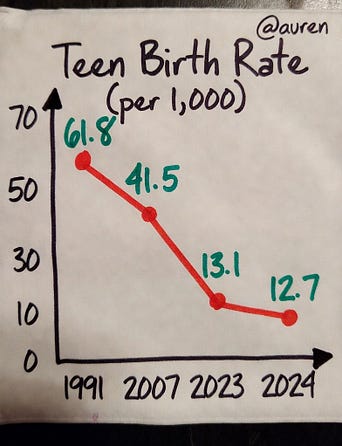
first: a tangent about the fertility ratewe all know the fertility rate is falling. it’s falling everywhere in the world -- with east asian countries (South Korea, Taiwan, China) being the lowest. it’s falling in the US too … but not nearly at the same rate as everywhere else. the US fertility rate hit 1.6 births per woman in 2024 -- the lowest ever recorded. but compared to South Korea (0.72) or Taiwan (0.87), we’re in a different universe. why? because the composition of who’s having babies in America has changed dramatically. and understanding this is key to understanding why AI could flip the script. a quick note on TFR, because it gets misunderstood. TFR doesn’t count actual babies born. it’s a synthetic estimate: take the birth rates for women at every age in a single year, add them up, and project how many kids a hypothetical woman would have over her lifetime if those rates held constant. but they never hold constant. when women delay having kids -- which is exactly what’s happening now -- TFR temporarily drops even if those women eventually have the same number of children. demographers call this the tempo effect. so a TFR of 1.6 doesn’t necessarily mean women will only have 1.6 kids. it might just mean they’re having them later. the real story: who stopped having babiesthe biggest driver of the US fertility decline isn’t that everyone’s having fewer kids. it’s that specific groups stopped having kids -- while married women have stayed relatively stable. teenagers having babies has declined massively. when i was growing up in the 1990s, teenage pregnancy was one of the hottest social issues. politicians talked about it constantly. there were task forces, public service announcements, entire cultural movements. today? it’s not even in the top 500 problems.
that’s a 79% decline from peak. the teen birth rate has fallen so much that it barely registers as a social issue anymore. the cause is almost entirely contraception. the Guttmacher Institute found that 86% of the decline from 1995-2002 was driven by better contraceptive use. for 2007-2012, improved contraception accounted for 100% of the decline -- it actually compensated for a slight increase in sexual activity. unmarried women are also having far fewer kids. the birth rate for unmarried women peaked in 2007-2008 at about 52 babies per 1,000 unmarried women of childbearing age. by 2023, it had fallen to 36.4 per 1,000 -- a 30% decline. that means only about 3.6% of unmarried women of childbearing age had a baby in 2023. unmarried women still accounted for 40% of all US births in 2023 -- about 1.44 million babies. but the rate keeps falling. but here’s the key finding: married mothers’ fertility has been remarkably stable. the birth rate among married women has been in the range of 80 to 90 births per 1,000 married women since the early 1990s. it dipped to a low of 80.8 in 2020 but rebounded to 84.2 by 2022. put simply: in any given year, about 8-9% of married women of childbearing age have a baby. that rate has been remarkably stable for decades. compare that to unmarried women: their birth rate in 2023 was just 36.4 per 1,000 -- meaning only about 3.6% of unmarried women of childbearing age had a baby that year. married women are more than twice as likely to have a child in any given year. married women aren’t having dramatically fewer kids. they’re having them later -- but they’re still having them. this matters. it means the fertility decline is primarily a story about:
the big shift is that fewer people are getting married. the marriage storyin 1960, the median age at first marriage was 20.3 for women and 22.8 for men. by 2023, it had increased to 28.4 for women and 30.2 for men. married women are more than 2.3 times as likely to give birth in any given year as unmarried women. so as marriage rates decline, fertility follows. but while marriage rates have declined a lot, divorce rates have fallen off a cliff. at the 1980 peak, about 23 out of every 1,000 married women got divorced each year. by 2023, that had dropped to about 14 per 1,000 -- a 36% decline. marriages that happen today are more durable than at any point in the last 50 years. so while people are less likely to get married, they’re more likely to STAY married when they do. and rich, educated people are still getting married at very high rates. marriage rates are closely linked to socio-economic status. in 2015, among adults 25 and older:
marriage for college-educated women has been remarkably steady: women born from 1940 all the way to 1980 have had about a 70% chance of being married in their 40s if they had four years of college. meanwhile, the rate for women without degrees has dropped precipitously. the never-married population is exploding. among 40-year-olds specifically: roughly 6% never-married in 1980 → 25% in 2021. that’s more than 4x higher. a note on how fertility is measuredthere’s an issue with how total fertility rate (TFR) is measured that makes things look worse than they are. TFR assumes current birth rates will persist at each age. but when people delay having children (as they increasingly do), TFR can understate actual completed fertility. a better measurement might be: how many babies are born per year to women 18-45 -- the actual childbearing window.
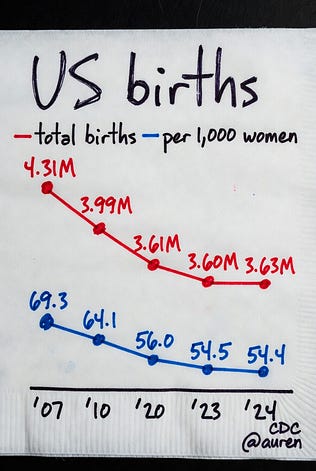
from 2007 to 2023, births declined 16%. but that’s largely driven by teens and unmarried women having fewer (often unplanned) babies. the intended fertility among married couples has been more stable. and critically: in 1990, women under 30 accounted for 70% of births. by 2023, they accounted for less than 49%. people are having babies later. technologies like IVF are making that possible. in 2023, 2.6% of all US births came from IVF -- over 95,000 babies. IVF cycles have more than doubled since 2011. enter AIok, so why do i think AI will reverse all this? reason 1: AI will make us focus on what’s truly human. as AI does more and more things that humans can do -- writing, coding, analyzing, researching -- we’ll increasingly focus on things that are truly human. like parenting. one thing AI can’t do is raise your child. can’t be present at dinner. can’t coach little league. can’t have the hard conversations. as work becomes more automated, the meaning we derive from work will shift. and for many people, that meaning will shift toward family. reason 2: AI will create abundance. if AI creates more economic abundance -- higher productivity, lower costs for goods and services, more wealth broadly distributed -- people will opt to have more kids. fertility is strongly correlated with economic optimism. when people feel secure about the future, they’re more willing to have children. AI could create a sustained period of economic growth that makes having a third (or fourth) kid feel feasible. reason 3: AI will boost religious belief. this is a contrarian prediction within a contrarian prediction: i think AI will create a boom in religious belief. when the world becomes increasingly digital and AI-mediated, many people will seek meaning in the opposite direction -- in tradition, community, and faith. and religious people get married earlier and have more kids. this is one of the most robust findings in demography. if religiosity increases, fertility follows. having babies is becoming THE status symbol
the best way to show you’re rich used to be the Ferrari or the elite golf club membership. increasingly, it’s by having 4 or more kids. this isn’t speculation. the data backs it up. women from the very richest households are now having more children than those less well-off. less than 28% of 40- to 45-year-old women in households earning below $500,000/year have three or more children. but 31.3% of families earning more than $500,000 do. while the average number of kids has fallen across the board over the last 30 years, it fell most dramatically for those at the bottom and middle. households earning less than $35,000 saw ~20% declines. households earning $150,000-$200,000 declined by only ~8%. why? economics. as wealthy people’s income rose faster than poor people’s, it became easier for them to hire help to care for their children and simultaneously have a career. the large american family is becoming a luxury good. the college arms race will endone of the biggest fertility killers in the upper classes is the college admissions arms race. parents feel enormous pressure to give their kids every advantage -- tutors, travel sports, extracurriculars, test prep. this is expensive, time-consuming, and scales terribly with more children. travel sports are fertility killers. it’s REALLY hard to have more than 2 kids in travel sports. the logistics alone -- different practice schedules, tournaments in different cities, the cost -- make it nearly impossible. But the personal AI tutor will make elite colleges less relevant. if a kid can get world-class personalized education from an AI -- better than any human tutor, available 24/7, infinitely patient -- the premium on getting into Harvard diminishes. and if the rat race to elite colleges slows down, so will the pressure to have your kids in travel sports. which removes one of the biggest barriers to having 3, 4, or 5 kids. self-driving cars change everythingthis sounds trivial, but it’s not. one of the hardest parts of having multiple kids is the logistics of ferrying them around. soccer practice, piano lessons, playdates -- parents become full-time Uber drivers. self-driving cars change this equation. yeah, you’d never put a baby in a self-driving car by itself. but you absolutely can use one to drop off your responsible 10-year-old at soccer practice. or pick up your 12-year-old from a friend’s house. and if cars don’t need steering wheels, ride-sharing fleets will have vehicles that accommodate 6+ passengers (and all their stuff). the minivan of the future will be a mobile living room -- like London cabs. this dramatically reduces the marginal cost (in time) of having additional children. artificial wombs (eventually)we’re probably 15 years from artificial wombs becoming viable. until then, one thing AI can help with is making pregnancies easier. a mother who has a tough pregnancy is much less likely to have another child. if AI-powered health monitoring, personalized nutrition, and predictive care can make pregnancies smoother, more women will opt for that next child. what could prevent the baby boomthe biggest issue is that marriage rates are declining. and since 60% of US babies are born to married parents (40% to unmarried), a decline in marriage means fewer babies. the real question is: how much more will marriage rates decline -- and can they recover? if the trend of rising never-married 40-year-olds continues (6% → 25% and climbing), the baby boom won’t happen. marriage is the leading indicator of fertility. but marriage rates among the wealthy and educated have held steady. if AI creates more prosperity broadly, marriage rates could stabilize or even recover among the middle class. why government policy mostly doesn’t workraising fertility rates is one of the most complicated policy problems. so much has been tried, almost nothing has worked. paid family leave doesn’t help much - and might hurt. this is counterintuitive. you’d think generous parental leave would increase fertility. the Scandinavian countries have the most generous leave policies in the world. their fertility rates? collapsing.
the differences in family policies across Nordic countries are not related to the strength of the recent fertility decline. the mechanisms remain unclear, but existing evidence points in directions beyond the influence of family policies. researchers have proposed several explanations:
why doesn’t leave help more? for high-agency career people, extended leave creates real penalties. it forces them to miss work, which makes their careers suffer. so they often limit themselves to 2 kids (spaced close together) and then signal to employers they’re “all-in on work again.” even more pernicious is paternity leave. when both parents take extended leave, it doubles the career penalty per child for the household. what might actually work:
instead of longer maternity/paternity leave, companies that want to be truly family-friendly should have onsite daycares. keep parents at work, but make it easy to be near their kids. second-order effects of the AI baby boomIf the AI baby boom happens, the ripple effects are enormous: self-driving cars will be 6-passenger by default -- like London cabs. the market will demand family-sized autonomous vehicles. longer time horizons for investors. a growing population leads to higher expected long-term GDP growth → higher equity risk premiums → different valuation dynamics. immigration to the US will plummet. if Americans are having more kids, the political and economic pressure for immigration decreases. and if AI reduces demand for low-skilled labor, immigration policy will tighten further. the US will care more about young people. social security and medicare benefits will flatten while education and infrastructure investments rise. this happening while life extension makes us have more people over 80 than ever before. politics will shift from “retirement and healthcare” debates to “childcare credits and home ownership” debates. world population will keep growing. all the population decline predictions will be wrong. if AI-driven fertility increases happen globally (especially in wealthy countries), world population could top 10 billion by 2070 and 12 billion by the end of the century. the bottom linemore abundance. more meaning from family (as meaning from work shifts). less pressure from the college arms race. easier logistics with autonomous vehicles. eventually, artificial wombs. all we need is for a family to think about having 3 kids instead of 2 as the ideal. if 3 becomes the aspiration (and of course some will have more), we’ll see a surge in births. american women had 3.6 million babies in 2023 -- the fewest in over 30 years, despite a much larger population. that number won’t stay there. give it 15 years. note: Flex Capital invests in 50+ seed-stage start-ups per year (1+ per week). typical first check is $500k. please reach out if you know amazing founders that want to change the world.
if you like this article, please do three things:
(if you hate this, please share with all your enemies) Hope you enjoy Summation by Auren Hoffman. Please also follow @auren on X.
|






Views