

I am in Hungary talking about cannabis and the insanity of American drug policy
 RE:
RE: RE ALL:
 FWD:
FWD:
I am in Hungary talking about cannabis and the insanity of American drug policySorry I haven't posted! I've been traveling. This is the speech I gave - it's mainly about cannabis, but I will have more to say about the discussion that followed.
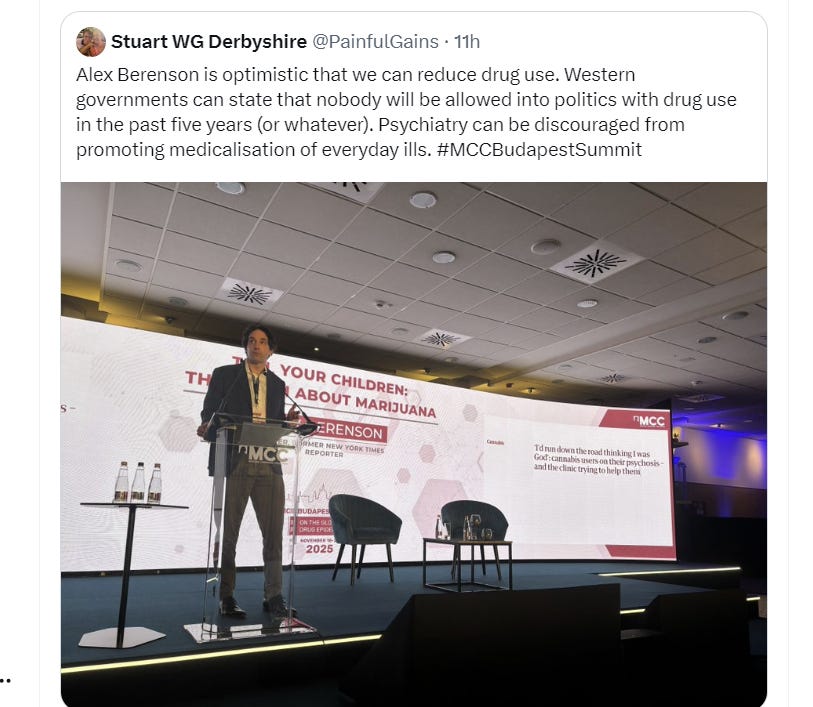
If you’re wondering where I’ve been the last few days… In September, Mathias Corvinus Collegium, a conservative-leaning Hungarian private university, invited me to speak at a conference on drug prevention in Budapest. It’s a bit of hike, but I’m glad I came. The conference includes some of the few other Americans speaking out against the normalization, commercialization, and medicalization of addictive, psychoactive drugs. (Plus Budapest is a beautiful city.) The questions and discussion at the conference have helped me think through a couple of issues around drug policy and why the American crisis has become so severe; I’ll come back to those. I still want to write a broad drug policy book (and a Wells novel too - you all have to stop keeping me so busy). Meanwhile, here’s the speech I gave today, which draws on Tell Your Children and focuses mainly on the mess that is American cannabis legalization. It’s a little longer than my usual pieces here, but I thought I should run it in full. Hope you enjoy it. — (Your support makes work like this possible. So thank you. Now, please, sign up if you haven’t!) — Thank you to MCC for having me, and for everyone who’s helped organize this event. Almost seven years ago, I wrote Tell Your Children, about the links between cannabis, psychosis, and violence. The United States drug legalization lobby and cannabis industry hated the book when it came out. They organized against it, trying to convince reviewers and major news outlets to ignore it, trying to smear me as racist and anti-scientific and a prohibitionist, trying to destroy Tell Your Children before anyone could read it. They thought they had succeeded. But they hadn’t. In 2019, I watched in disappointment as the left-leaning legacy media knuckled to the pressure it faced. Outlets like the New York Times, where I had worked for a decade from 1999 to 2010, declined to review Tell Your Children. NPR canceled an interview with me. And the Guardian, Britain’s best-known “progressive” news outlet, ran a piece calling TYC “pure alarmism.” -- Nearly seven years later, though, Tell Your Children remains a bugaboo for cannabis advocates and an important part of the debate around legalization. It continues to sell solidly. More importantly, people continue to contact me having said they’ve found and read it and it has helped them – or their kids – understand the harm that cannabis has caused them. Most books – fiction or non- – are quickly forgotten (this is the saddest part of being an author, and one I’m glad I didn’t know when I started writing), so it’s gratifying on some level that Tell Your Children has had such a long half-life. But I wish it hadn’t. The reason TYC continues to resonate is that the negative effects of heavy cannabis use are becoming more and more obvious across the United States now that most states have legalized cannabis either recreationally, medically, or both. Even at the federal level, the Hemp Bill of 2018 opened the way for the effective backdoor legalization of many cannabis products – although Congress has just in the last two weeks recriminalized those products. Across the United States, from Maine to California, cannabis and THC – the psychoactive chemical in it responsible for its high – are available in legal dispensaries. Even in states that have not legalized, the Hemp Bill allows the sale of THC extracts in drinks, gummies. Slightly chemically different forms of THC are also widely available. You may have heard about the fight over “descheduling” cannabis in the United States – moving it to a somewhat less restrictive designation as a controlled substance. The cannabis industry desperately wants the Trump Administration to deschedule. Doing so would give stores and cannabis producers – I won’t say farmers, as they’re mostly chemists these days -- more access to the banking system and lower taxes. But make no mistake, with or without descheduling, the United States has effectively legalized cannabis. -- (Greetings from Central Europe!)
New polls suggest that more and more Americans wish that it hadn’t. A poll in New York, my home state, in April showed that about twice as many New Yorkers believed that legalization had worsened their quality of life as had improved it. And earlier this month, a poll from Gallup found that support for legalized cannabis had dropped 4 percentage points since last year and 6 percentage points from its high in 2023, to the lowest level since 2017, when legalization really took off. Most Americans do still favor legalization. That fact is disappointing but not surprising. It follows two decades of pro-cannabis and pro-legalization propaganda from both Hollywood and the legacy news media. To be blunt – or maybe I should say to be frank – Americans were lied to. They were told that drivers who were high would drive slowly and carefully. But cannabis-impaired drivers account for up to 15 percent of deaths in states like Colorado – 87 out of 659 deaths in 2023. Increased cannabis use is probably a key reason that the United States has now become a more dangerous place to drive than Europe. They were told that cannabis was essentially safe for use, that unlike alcohol it did not have any serious negative physical impacts. But new research shows that THC has serious cardiac effects – and these effects remain whether THC is smoked or ingested in other ways, like through food or gummies. Just how many heart attacks and cardiac deaths cannabis causes is unclear, but it is causing them. They were told that legalization would eliminate the illicit market in cannabis farming and sales. But in states like California, the cost of regulation, insurance, and commercial stores mean that illegal cannabis is cheaper and just as accessible as the legal product, and the illicit market remains large and violent. Legalization has led to the worst of both worlds, allowing commercial producers to advertisers for new users who might be reluctant to buy illegal cannabis but are willing to try it now that it’s been legalized, while doing nothing to curb the illicit market. Meanwhile, new users who become heavy users and then addicted may “graduate” to the cheaper black market to supply their growing needs more cheaply. They were also told that legalization would produce huge new tax revenues, but because the legalized market cannot compete with illicit producers, taxes have fallen far short of expectations – and in California, some legal producers are now asking the state to bail them out. And they were told that cannabis was not addictive. Indeed, cannabis is not as physically addictive as alcohol or opioids. But that fact does not mean it is not strongly psychologically addictive, like cocaine or amphetamine. Particularly with THC vapes or “new” cannabis, which frequently has very high levels of THC, users seem to split into two categories. Many people do not like the THC high or the paranoia that it often brings and use the drug only occasionally – or not at all after experimenting with it a few times. — (It’s not paranoia if they’re really after you, right? Right?!? Subscribe to find out…) — But for whatever reason, a significant percentage of people find the high compelling and very rapidly begin using it daily, often for most of their waking hours. Because cannabis is not as physically harmful as alcohol, and because of its legal status and the heavily promoted cultural norms around it, these people are able to rationalize their use. At best, though, he heavy daily use of cannabis – like alcohol – leads to problems at work and home for many users. It reduces motivation and damages memory. I personally know people whose lives were derailed by heavy cannabis or THC use. You may too. Often they were talented as teens, but as adults they didn’t marry, have career success, or have families. They simply seem almost frozen in time, to be watching their lives pass without much desire to do anything except use cannabis. But that isn’t the worst outcome. At worst – and the worst happens a small but significant fraction of the time – cannabis and THC lead to paranoia, psychosis, and psychosis-related violence. I wrote about these crises in Tell Your Children, how users would continue to smoke cannabis or consume THC despite their mounting paranoia, and how that paranoia would lead to psychosis. The industry and legalizers hate discussing this issue. Hate is not too strong a word. They know that nothing would lead to a backlash against cannabis more quickly than a true understanding of its risks to the brain. “Reefer Madness,” they say, referring to the 1936 movie that was originally titled - wait for it - “Tell Your Children.” But reefer madness is real. Cannabis does have severe psychiatric consequences for many people who use it. And the newer, higher potency products clearly have even higher risks, because they make consuming enormous amounts of THC easy. No need to make brownies or smoke until your throat is sore, just hit your vape or eat a gummy. Or, increasingly, drink a soda spiked with THC. Last Sunday, almost seven years after trashing my book warning of this crisis, none other than the Guardian admitted the truth. See for yourself. — (Guess I’m not an alarmist anymore)
— The risks are particularly high for young adults, whose brains undergo crucial rewiring in their late teens. We need do everything we can to make cannabis less accessible to people in their teens, particularly in their early teens. Hollywood and the legacy media need to highlight these risks and discourage use. But legalization makes cannabis more accessible to the teenagers at the highest risk, and decades of propaganda have convinced them the drug is safe to try. Most of them – like most adults – will find that they don’t like the intensity of the high that new THC products give them. But some will. And some of those will progress to dangerous and heavy use. Americans are seeing the results, seeing their lives of their own kids or children they know derailed, or worse, by THC. Slowly, the backlash to legalization is beginning. I believe it will become more intense. I cannot claim to predict what will happen politically or if any legalized state will undo its decision, but I believe that cannabis use will become more stigmatized culturally. That change cannot happen soon enough. Because in the meantime, we are losing minds and even lives to THC. Tell Your Children. You're currently a free subscriber to Unreported Truths. For the full experience, upgrade your subscription.
|





Views